Lummi Island Wine Tasting March 24 Spring Equinox ’12
Equinox Equinox Equinox

As you all know the Spring (or Vernal) Equinox was just a couple of days ago. Astronomically speaking it just about coincides with St. Patrick’s Day. And as we have pointed out before, just about every major Christian holiday coincides with an ancient pagan holiday, most of which were tied to major events on the solar calendar– solstice, equinox, and “cross-quarter days,” and St. Patrick’s Day is no exception.
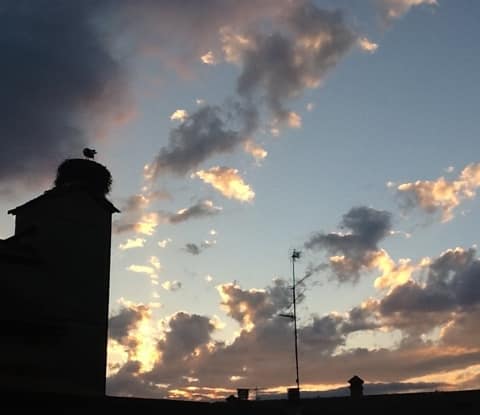
And although it was too cloudy to get a picture of sunset on the actual equinox (March 20, 1:14 A.M. EDT), I did get one the day after. You can see in the following photos that the movement of sunset since the Winter Solstice just about transits our view of Orcas Island.
(in sequence: Dec 21, Feb 2, March 21)
THE NEXT ART OF WINE Workshop is SUNDAY, April 1!
The Art of Wine in Germany
One of my favorite experiences in the wine shop is pouring a riesling at one of our tastings. Inevitably a number of people will dismiss it, saying “Oh, no thanks, I don’t like sweet wines.” Then when they taste it, their eyes widen and appreciation dawns. Riesling is one of the most complex and versatile of wine grapes, with layers of subtle flavors and enough acidity to produce a family of wines from the very crisp and dry to drippingly sweet with perfectly balanced, palate-refreshing acidity.
In this unusual tasting workshop, you can explore the broad range of personalities riesling can take on, while pondering the philosophy of Nietzsche, the awe-inspiring power of Wagner, and the fantastic, surrealistic visons of Max Ernst and
Goethe.
nearly full, call now! (758-2020)
See flyer for details
We just restocked one of the Aglianico wines we often carry. Aglianico is an ancient grape, probably originating in Greece millennia ago, in pre-Roman times. It was reputedly introduced into Italy by Hellenes from ancient Greece who settled in southern Italy and planted the vine in volcanic soil on the sunny slopes of Monte Vulturino. In character, Aglianico is most similar to Nebbiolo, having high acidity, high tannins and ripening late in the growing season, which lends to the grapes’ heady aromas. Yet where Nebbiolo tends to offer more red fruits, Aglianico features more wild black fruits and and more assertive, rustic tannins, which soften with extended aging. Modern techniques also seem to have tamed the grape’s more challenging qualities. sometimes giving it a soft, fruity, almost pinot noir-like quality. This variety was called Vitis hellenica, later being called Ellenico and in the fifteenth century Aglianico, as it is known today. It’s an interesting and seductive grape, one of my favorites.
Syrah Syrah Syrah
Last week one of our faithful followers mentioned that she was on a quest for just the right syrah. What she described in delicious terms was very much my idea of the perfect syrah, best exemplified (imho) by the wines of the Northern Rhone region in France, from Cornas, Hermitage, and Crozes Hermitage. I thought we had such a wine on board, but OMD! it was all gone. It is so weird, we can have a vintage of wine around our place for years before it sells out, and when it goes it seems to go all at once. To some degree that is an endorsement of cellaring wines for a few years, because many of these wines we have poured for you several times, but it isn’t until the strands of flavor and texture come together that the Group Palate responds, gasping, wanting more. But then, of course, it is Too Late! I suspect we are unique in this respect as a wine shop, since most places move the wine in and move the wine out. But our volume is so low, sometimes wines hang around here for years.
Anyway, a few weeks ago we did by chance bring in a few bottles of a very nice Washington syrah from Riveraerie Winery that we poured on a Friday night to rave reviews (only one bottle left!). So we just got another case, and we are pouring it this weekend. A little richer and brighter than its Northern Rhone counterpart, but pretty seductive– I think you’re gonna like it!
This week’s wines:
Naia Las Brisas ’09 Spain WA89pts $11
An old favorite, this a blend of 50% Verdejo, 30% Viura, and 20% Sauvignon Blanc; medium straw-colored, it offers an amazingly complex perfume of fresh herbs, spring flowers, baking spices, and white peach that lead to a ripe, concentrated, nicely balanced wine that way over-delivers for its price point.
Vinosia Aglianico ’08 Italy WA89pts $12
Deep garnet-purple color. Raisin, blueberry and underbrush aromas. Some dried rose petals and spice. Crisp acidity and a medium+ body. Medium+ level of velvety tannins. Long finish.
Domaine Escaravailles les Sabliers ’10 France $14
The tasty, spicy 2010 Cotes du Rhone Les Sabliers (a blend of 70% Grenache and the rest Syrah and Mourvedre) exhibits a seductive style filled with black cherry and strawberry fruit intermixed with Provencal herb and earth notes. Medium-bodied, deliciously fruity, pure and well-made.
Riveraerie Syrah Columbia Valley ’07 Washington WS92pts $19
Smooth and velvety, offering a plush mouthful of cherry, plum and rhubarb flavors that glide into the long, expressive finish, hinting at pepper and dark chocolate. Best from 2013 through 2018.
Lummi Island Wine Tasting St. Patrick’s Day ’12
Saint Patrick Saint Patrick Saint Patrick
I first learned about St. Patrick’s Day when I was about 5 years old. My mother was of Irish descent from both sides of her family (Collins and Gillis), and mighty proud of it. So she would NEVER have let us go to school on March 17 without at least some display of the Green. Not only did that mean some article of clothing, but it also meant wearing one of two little pins she had; one was a leprechaun, and the other was a shamrock. Now, bein’ Irish meself, I got nuthin’ against shamrocks, but when I was a little boy, sure and I did have a preference for wearin’ the leprechaun over the shamrock. And of course I have no idea why…it was just kinda cute is all!
That o’course raises the question of why we wear green in the first place on St. Patrick’s Day, eh? Well, why do you suppose, because originally some say that green was an Unlucky color in Ireland and that the color for St Pattie’s Day was Blue , not Green. (who knew?). In our family, at least, the explanation that makes most sense is the separation between Catholics and Protestants: Catholics wore green and Protestants wore orange. That is why the Irish flag has three stripes–green for the Catholics, orange for the Protestants, and white for peace between them. If ya don’t wear green, it’s a disappointment, but if ya wear orange, sure ‘n’ yer gonna get pinched!
Of course, we know “peace” between the Irish Protestants and Catholics has not always been an easy road–not in Ireland, not in America. My mother used to tell stories of her childhood in Maine (where I grew up, too), when the KKK was active even in the North, and cross-burnings and violence were directed against Catholics, and it was pretty scary. Her father was “the Catholic dentist,” distinct from the rest, so there was a solid cultural divide. Now, it is of course a comfort to know that here in 2012 America the Catholics and Protestants (and Mormons) are no longer divided, and have united whole-heartedly toward the peaceful respect of all religious and secular points of view…… Thus we measure our progress…and upon reflection, that may explain why you don’t have to be Irish to need a drink from time to time…and of course We Are Here For You, regardless of your religious orientation… Wine is religion-neutral, as any good leprechaun knows!
I will also take a moment on St. Pattie’s Day to offer a toast to me dear departed mother, proud to her dying breath of her Irish roots. “Remember,” she would often entreaty us, “you’re a Collins!” And proud of it, Mum, proud of it!
THE NEXT ART OF WINE Workshop is THIS SUNDAY, March 18!
The Art of Wine in Italy
Ah, si, signoras et signori, pair a fleshy Valpolicella with the lively Baroque strings of Vivaldi…ponder the celestial tableaux of Michelangelo while savoring a bold Super-Tuscan blend of sangiovese and cabernet…try Fellini with a tipple of the ancient grape malvasia…taste the wines, hear the music, see the art, hear the poetry…now That is Terroir!
ALSO— The last workshop in this series is in two weeks…The Art of Wine in Germany, and is already nearly full, so call now!
See flyer for details about each workshop, and call Ryan soon to reserve your place (758-2020)…only two spaces left!
Javier Javier Javier
Probably because the Heritage Trust annual dinner was last Saturday, many of our regulars came by last Friday night instead of Saturday…quite festive! That made Saturday more of a day for visitors; now that the Willows is open again, we are seeing more new faces each weekend who are staying at the Inn or one of several other rentals the Willows is now managing.
As most of you know, our shop is up a narrow stairwell such that we hear the door open and footsteps all the way up the stairs, but don’t see the arriving guests until they reach the top and enter the room. Everyone gets a greeting (unless we are Really Busy), and even after seven years we most often recognize anyone who has ever been in before. We can also usually tell if we have not seen someone before. It gets tricky, though, if someone you have seen somewhere else comes in, so they look familiar, but not in our setting.
So it was last Saturday when a charming young couple came in, and though they had not been in before, he knew me and knew the shop. And he looked familiar, but from where??? It turns out they were Javier and Shyla Alfonso, owners of Pomum Cellars in Woodinville- Javier is one of my favorite Washington winemakers! He is Spanish by birth, having grown up in the famous Spanish wine region of Ribero del Duero. His Tinto (teen-to) wine is made from tempranillo (temp-r-r-r-aneeyo) grapes, like the wines of his childhood home. We have carried the Tinto, his top blend called “Shya” (named after his wife!), and his Pomum Red blend. In honor of his visit last weekend we will be pouring the Pomum Red this weekend. Salud!
This week’s wines:
Alta Vins Domus Pensi Blanc Spain $11
Bracingly clean and zippy, this garnacha blanca comes from 1200 ft altitude from the Terra Alta region in the hills near Tarragona. (We’re going there next month!)
Alta Vins Crianza Spain $18
From the same producer, a red blend with balanced French oak and integrated tannins yielding soft notes of vanilla, rhubarb, cinnamon, and highland coffee. Try with foie gras or grilled onions!
Leese-Fitch Cabernet 09 California $10
Deep ruby in color, the nose has notes of black cherry, root beer syrup, and cedar. The 2009 vintage of Leese-Fitch Cabernet has flavors of rich berry cobbler, cappuccino, chocolate covered mints, currants & fig cake. It finishes with toasted marshmallows and dried blueberries.
Pomum Red 08 Washington $19
40% Cabernet Sauvignon, 30 % Syrah, 10% Merlot, 10 % Cabernet Franc and 10% Malbec from an array of top vineyards in the Yakima Valley including DuBrul, Upland and Dineen . The wine is brick-red in color with noticeable exotic spice and dried herb aromas. On the palate, the wine expresses tart red cranberries and cherries. The finish, long and smooth.
Lummi Island Wine Tasting St. Patrick’s Day ’12
Saint Patrick Saint Patrick Saint Patrick
I first learned about St. Patrick’s Day when I was a small child. My mother was of Irish descent from both sides of her family (Collins and Gillis), and mighty proud of it. So she would NEVER have let us go to school on March 17 without at least some display of the Green. Not only did that mean some article of clothing, but it also meant wearing one of two little pins she had; one was a leprechaun, and the other was a shamrock. Now, bein’ Irish meself, I got nuthin’ against shamrocks, but when I was a little boy, sure and I did have a preference for wearin’ the leprechaun over the shamrock. And of course I have no idea why…it was just kinda cute is all!
That o’course raises the question of why we wear green in the first place on St. Patrick’s Day, eh? Well, why do you suppose, because originally some say that green was an Unlucky color in Ireland and that the color for St Pattie’s Day was Blue , not Green. (who knew?). In our family, at least, the explanation that makes most sense is the separation between Catholics and Protestants: Catholics wore green and Protestants wore orange. That is why the Irish flag has three stripes–green for the Catholics, orange for the Protestants, and white for peace between them. If ya don’t wear green, it’s a disappointment, but if ya wear orange, sure ‘n’ yer gonna get pinched!
Of course, we know “peace” between the Irish Protestants and Catholics has not always been an easy road–not in Ireland, not in America. My mother used to tell stories of her childhood in Maine (where I grew up, too), when the KKK was active even in the North, and cross-burnings and violence were directed against Catholics, and it was pretty scary. Her father was “the Catholic dentist,” distinct from the rest, so there was a solid cultural divide. Now, it is of course a comfort to know that here in 2012 America the Catholics and Protestants (and Mormons) are no longer divided, and have united whole-heartedly toward the peaceful respect of all religious and secular points of view…… Thus we measure our progress…and upon reflection, that may explain why you don’t have to be Irish to need a drink from time to time…and of course We Are Here For You, regardless of your religious orientation… Wine is religion-neutral, as any good leprechaun knows!
I will also take a moment on St. Pattie’s Day to offer a toast to me dear departed mother, proud to her dying breath of her Irish roots. “Remember,” she would often entreaty us, “you’re a Collins!” And proud of it, Mum, proud of it!
THE NEXT “ART OF WINE” Workshop is THIS SUNDAY, March 18!
The Art of Wine in Italy
Ah, si, signoras et signori, pair a fleshy Valpolicella with the lively Baroque strings of
Vivaldi…ponder the celestial tableaux of Michaelangelo while savoring a bold “Super-Tuscan” blend of sangiovese and cabernet…try Fellini with a tipple of the ancient grape malvasia …taste the wines, hear the music, see the art, hear the poetry…now That is Terroir!
ALSO— The last workshop in this series is in two weeks…The Art of Wine in Germany, and is already nearly full, so call now!
See flyer for details about each workshop, and call Ryan soon to reserve your place (758-2020)…only two spaces left!

Probably because the Heritage Trust annual dinner was last Saturday, many of our regulars came by last Friday night instead of Saturday…quite festive! That made Saturday more of a day for visitors; now that the Willows is open again, we are seeing more new faces each weekend who are staying at the Inn or one of several other rentals the Willows is now managing.
As most of you know, our shop is up a narrow stairwell such that we hear the door open and footsteps all the way up the stairs, but don’t see the arriving guests until they reach the top and enter the room. Everyone gets a greeting (unless we are Really Busy), and even after seven years we most often recognize anyone who has ever been in before. We can also usually tell if we have not seen someone before. It gets tricky, though, if someone you have seen somewhere else comes in, so they look familiar, but not in our setting.
So it was last Saturday when a charming young couple came in, and though they had not been in before, he knew me and knew the shop. And he looked familiar, but from where??? It turns out they were Javier and Shyla Alfonso, owners of Pomum Cellars in Woodinville- Javier is one of my favorite Washington winemakers! He is Spanish by birth, having grown up in the famous Spanish wine region of Ribero del Duero. His Tinto (teen-to) wine is made from tempranillo (temp-r-r-r-aneeyo) grapes, like the wines of his childhood home. We have carried the Tinto, his top blend called “Shya” (named after his wife!), and his Pomum Red blend. In honor of his visit last weekend we will be pouring the Pomum Red this weekend. Salud!
This week’s wines:
Alta Vins Domus Pensi Blanc Spain $11
Bracingly clean and zippy, this garnacha blanca comes from 1200 ft altitude from the Terra Alta region in the hills near Tarragona. (We’re going there next month!)
Alta Vins Crianza Spain $18
From the same producer, a red blend with balanced French oak and integrated tannins yielding soft notes of vanilla, rhubarb, cinnamon, and highland coffee. Try with foie gras or grilled onions!
Leese-Fitch Cabernet 09 California $10
Deep ruby in color, the nose has notes of black cherry, root beer syrup, and cedar. The 2009 vintage of Leese-Fitch Cabernet has flavors of rich berry cobbler, cappuccino, chocolate covered mints, currants & fig cake. It finishes with toasted marshmallows and dried blueberries.
Pomum Red 08 Washington $19
40% Cabernet Sauvignon, 30 % Syrah, 10% Merlot, 10 % Cabernet Franc and 10% Malbec from an array of top vineyards in the Yakima Valley including DuBrul, Upland and Dineen . The wine is brick-red in color with noticeable exotic spice and dried herb aromas. On the palate, the wine expresses tart red cranberries and cherries. The finish, long and smooth.
Quilceda Creek 2009 Cabernet Sauvignon is here!
Through an odd set of circumstances, we have apparently received our annual allocation of the new 2009 QC cab before any other wine shops in the State. Now I know that doesn’t mean a thing to most of our regular visitors and followers, so as a result we still have most of the QC releases from the past six years or so in stock. Someday, we suppose, the word will get out and collectors will beat a path to our door for it, right…? So this post is a bit of an experiment, really, triggered by this curious moment in which we are the first shop in the State to have the wine in stock. (And like most of the other vintages, we will probably still have ours years after everyplace else has long since sold out!)
For those of you who don’t know, Quilceda Creek is one of the world’s very best producers of cabernet sauvignon, having earned unprecedented critical acclaim, its last eight vintages having earned nearly perfect scores of 99-100 points from critic Robert Parker. Suffice it to say it is highly regarded and rarely appears on wine shop shelves (except, you know, out here on the Frontier…)!
Robert Parker’s review:
The 2009 Cabernet Sauvignon Columbia Valley might, in the long run, prove to be at an even higher level (than the ’08). This beautifully proportioned, fragrant Cabernet deftly combines elegance and power. Give it a minimum of 4-5 years of additional cellaring and drink it through 2034.99-100 pts
Read Winemaker Paul Golitzin’s comments on the wine.
Anyway, we have a few bottles available at $190 per bottle. If you are interested drop us an email (info@artisanwineclub.com) or give a call (360.758.2959).


2072 Granger Way